



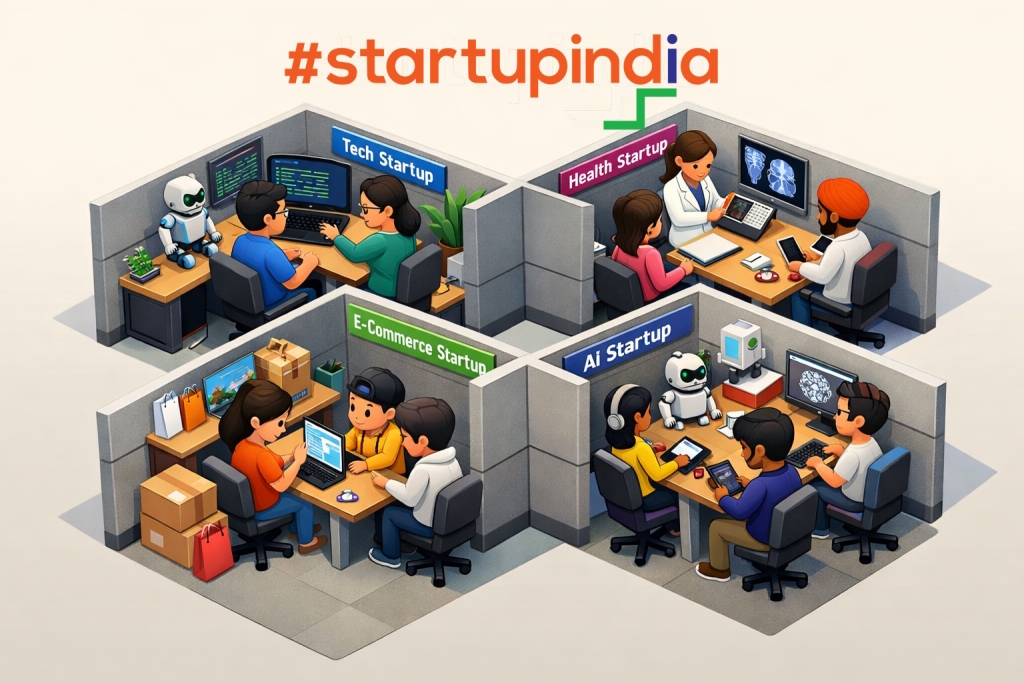




On this 16th January, India celebrated its National Startup Day. This year the event carried a special weight. Although this comes every year, this is the 10th anniversary of the launch of the Startup India Mission which officially recognizes startups as a business category. Thus, the startups of India are celebrating a decade of unprecedented growth and momentum which may be the most significant development in the business sector of India in recent years.
While the traditional business economy of the country has been steadily growing as well, the need for a Startup program was felt as long back as the early 2000s when in the post Y2K world, India took on the place as a global destination for outsourcing. That era was particularly marked by the development of Silicon Valley Startups which were starting to attract IIT Graduates of the India. By Mid 2000s, YC and Stanford backed startups were becoming dream destinations for Indian Techies. Some of the early Indian startup Founders like Kunal Bahl were inspired by that new trend in USA.
However, until 2016, there was no formal ecosystem which treated startups differently from other MSME business, trade or services. Manufacturing was capital intensive, there were almost no design studios, prototyping was a nightmare, IPR was a mounting challenge and a fringe activity, while most startup dreams died on college campuses.
Why need startups? Aren’t all new businesses Startups?
Although the word ‘Startup’ can be associated with any new business, it carries a specific connotation around quick scaling, innovative, technology driven businesses which are able to transform the traditional business landscape. Growth of startups is considered an economic indicator for a nation with aspirations. Another reason for encouraging startups is to create jobs. Typically, the traditional and family owned businesses are slow in growth and they add fewer new jobs where innovative startups create new opportunities and potentially bring new jobs where there were none.
The Government of India under its Startup India Mission, for providing benefits under their various schemes, details out a definition for Startups in following terms:
- The period of existence and operations should not exceed 10 years from the date of incorporation.
- Incorporated as a Private Limited Company, a Registered Partnership Firm, or a Limited Liability Partnership
- Should have an annual turnover not exceeding Rs. 100 crore for any of the financial years since its incorporation.
- An entity should not have been formed by splitting up or reconstructing an already existing business.
- Should work towards development or improvement of a product, process, or service and/or have a scalable business model with high potential for the creation of wealth and employment.
Source: https://www.startupindia.gov.in/content/sih/en/startup-scheme.html
This definition helps distinguish startups from other businesses, ensuring that government benefits are targeted toward enterprises with innovation-led potential.
Geopolitical relevance of Startup Program
Many would wonder why should a country invest in fuelling and sustaining fledgling and highly risky businesses in the name of supporting startups? Aside from personal egos of founders, entrepreneurial zeal and Government’s ambitions to build the next Silicon Valley, there are very real reasons why startups are relevant to the economy:
1. Global Markets are fast changing which creates new challenges and require innovation to solve.
2. Those moving forward with technology and playing their part in development of new technology have the edge over competitors
3. Traditional businesses generally use existing technologies and don’t have moats
4. Without startups, countries stall and become overly dependent on imports.
6. Startups not only create more competition but also build new categories.
Today India stands as the third-largest startup ecosystem (after U.S. and China) by number of startups. Global tech investors and companies (e.g., Google) are launching targeted programs to help Indian startups access markets and scale. Indian institutions like IITs, IIITs, IIMs and other premier colleges have set up a vast network of incubators.
Overall Assessment – “Where India Was vs. Now”
| Metric | Around 2016 | By Early 2026 |
| Recognised Startups | ~500 | ~200,000+ |
| Unicorns | ~4 | ~125+ |
| Startup Jobs | N/A | ~17+ lakh |
| Global Rank | Emerging | #3 in world |
| Tier II/III participation | Limited ecosystem | ~50 % |
Data: DPIIT
This shows how far India has come in the Startup sector over the last decade. There are Angel Investing Networks, Founder Communities, Incubators, Mentor Networks, State Programs and so many other stakeholders which have formed around the startup sector. Perhaps with this growing influence of startups within the overall economy of the country, it’s time to formalise the Startup India Mission into a designated Department or Ministry like the MSME, Corporate Affairs and not just as a program under the Department of Promotion of Industry and Internal Trade of India.
A More Inclusive, Impactful, and Institutionally Mature Ecosystem
As the Startup India Mission enters its second decade, its most enduring legacy may lie not just in headline valuations or unicorn counts, but in how deeply and widely entrepreneurship has permeated Indian society. Over the last ten years, the startup ecosystem has evolved from being metro-centric and founder-homogeneous into one that is increasingly inclusive, geographically dispersed, and structurally supported.
Inclusive growth and diversity stand out as defining shifts. Tens of thousands of DPIIT-recognised startups today report at least one woman founder or director, signalling a steady-if still incomplete-broadening of leadership representation. Equally significant is the geographic rebalancing of entrepreneurship: more than half of India’s startups now emerge from Tier II and Tier III cities rather than traditional hubs alone. This expansion reflects not only improved digital infrastructure and access to capital, but also a cultural shift where entrepreneurship is no longer confined to a few urban elites. Innovation is increasingly rooted in local contexts, addressing region-specific problems while contributing to national growth.
In terms of job creation and economic impact, startups have moved from being perceived as niche disruptors to becoming meaningful engines of employment and productivity. As of late 2024, DPIIT-recognised startups have generated over 17 lakh direct jobs, with many more created indirectly across supply chains and services. Importantly, this employment growth is not limited to one sector. The diversification into fintech, health-tech, AI, SaaS, climate tech, and deep-tech underscores a maturing ecosystem that is innovating beyond India’s traditional IT services stronghold and aligning more closely with future-facing economic needs.
A Run for AI Dominance
In recent years, the Government of India has significantly strengthened the AI layer of the startup and innovation ecosystem through a set of complementary, inclusion-focused initiatives. The IndiaAI Mission anchors this effort by building large-scale public AI infrastructure, including a shared national compute platform with tens of thousands of GPUs, aimed at democratising access to high-end AI resources for startups, researchers, and academia. Initiatives such as Bhashini and AI4Bharat focus on linguistic inclusion, enabling AI solutions across multiple Indian languages through open datasets, translation, and speech technologies-critical for reaching India’s diverse population. The government’s free or subsidised GPU schemes further lower entry barriers for AI innovation, particularly for early-stage startups and foundational model development. Together with the push for Public AI and indigenous foundational models trained on Indian data, these measures signal a shift toward sovereign, accessible, and socially relevant AI, reinforcing India’s ambition to build an AI ecosystem that is not only globally competitive but also broadly inclusive and publicly beneficial. Will cover this element of India’s startup focused growth at length in another article soon.
Underlying this progress is the steady strengthening of ecosystem infrastructure. Over the decade, India has built a dense network of incubators, accelerators, and mentorship platforms that support founders across stages and sectors. Creation of the Startup India Hub and platforms like the BHASKAR knowledge registry and Maarg Portal have improved information access, discovery, and institutional coordination, while industry partnerships and global collaborations have opened pathways to markets, capital, and technical expertise. Collectively, these mechanisms have reduced entry barriers and helped transform entrepreneurship from an individual leap of faith into a more systemically supported career path.
Taken together, these trends point to an ecosystem that is no longer merely growing in numbers, but maturing in character – more inclusive in who participates, more impactful in what it contributes, and more resilient in how it is supported. This evolution provides a fitting lens through which to conclude the Startup India story so far: not as a finished success, but as a foundational shift in how India builds, backs, and benefits from innovation.
This article is contributed by a presumed industry expert. The Local Brand® does not endorse any advice, opinion, services or products suggested by the author. The article may have been edited by our team.