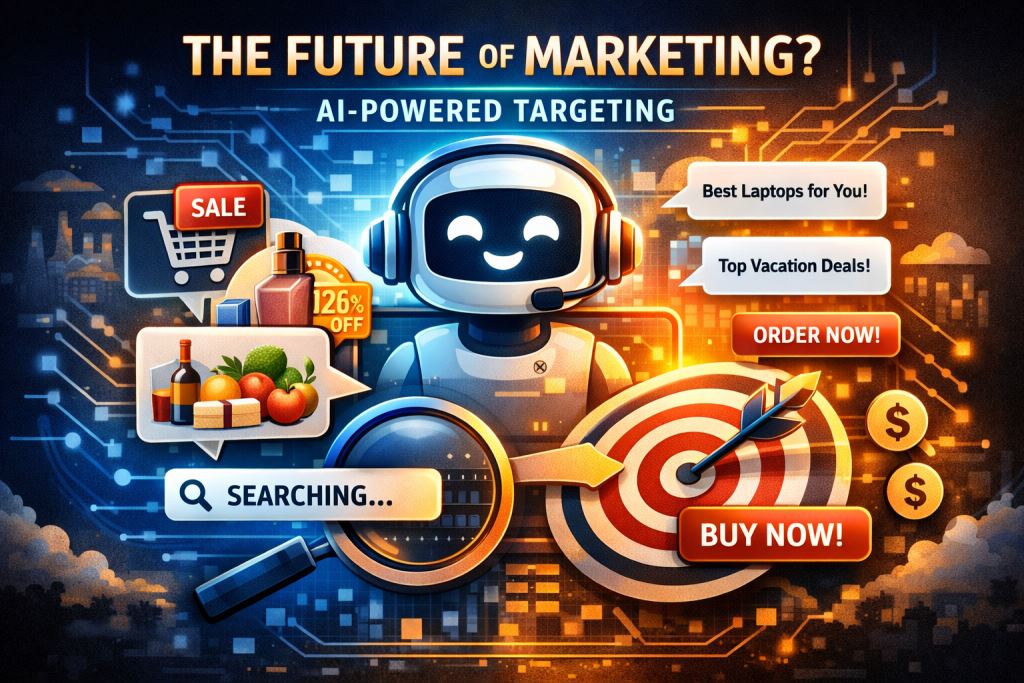









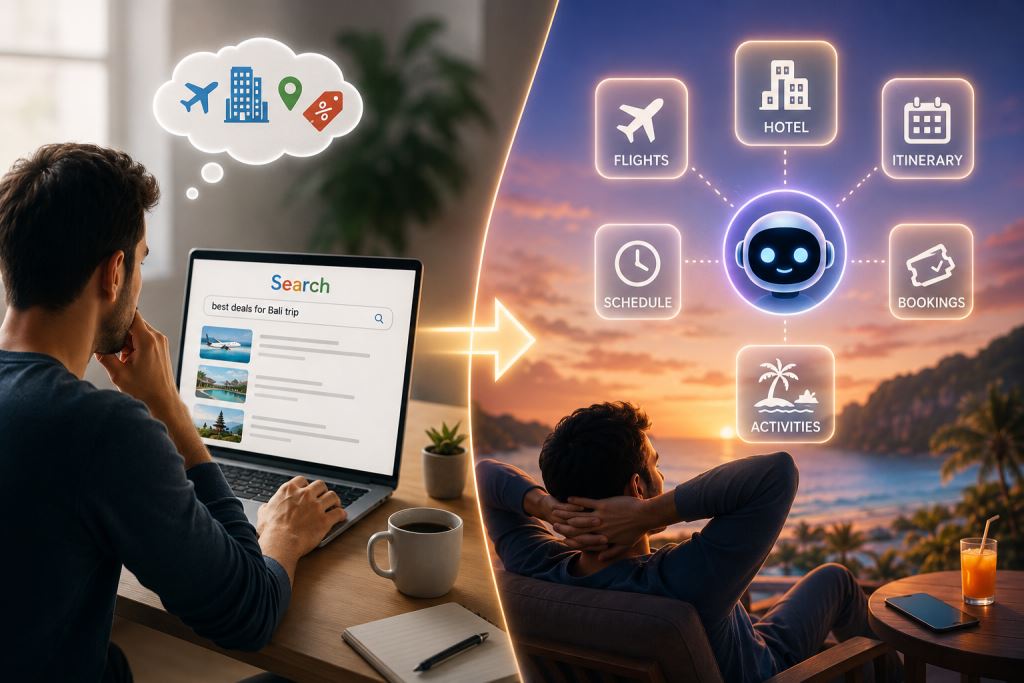
Artificial Intelligence is steadily replacing the traditional search engine as the primary gateway to the internet. For nearly two decades, the internet experience revolved around keywords, links, and pages of ranked results. Users had to search, compare, filter, verify, and finally decide. AI changes that equation entirely. Instead of merely showing information, modern Large Language Models (LLMs) are beginning to interpret intent, synthesize knowledge, and deliver contextual answers directly.
This shift is becoming especially visible in complex decision-making tasks. Earlier, finding the right travel destination, the best restaurant within a budget, or the most suitable grocery options required browsing multiple websites, reading reviews, comparing maps, and manually evaluating choices. Today, LLMs are increasingly dependable at handling such layered queries because they can combine context, preferences, pricing, location intelligence, reviews, trends, and historical patterns into a single recommendation flow. The user no longer searches for information alone; the AI helps arrive at a decision.
What’s fueling this change
Several forces are accelerating this transformation. The first is the unprecedented availability of data. Every service, product, location, and human preference now generates digital footprints that AI systems can process. The second is better cross-domain referencing. Modern AI systems are capable of connecting information from entirely different fields simultaneously – geography with consumer behavior, finance with logistics, psychology with purchasing patterns, healthcare with wearable data, and so on. The third driver is sheer computational speed. Faster processing infrastructure and more efficient models now allow real-time reasoning over enormous volumes of information, making AI responses increasingly practical and reliable for everyday use.
Most importantly, there is virtually no barrier to using AI anymore. There are countless platforms, models, and AI-enabled services available today. Access is no longer limited to researchers or technology companies. It is now simply a matter of intent – if someone wants to create, solve, automate, or explore something, AI tools are already available to assist.
Chatbots to Agents – What’s really replacing humans at workplace
At the same time, AI is rapidly evolving beyond the role of a chatbot companion that merely answers questions. We are entering the age of AI agents – systems capable of executing tasks in the real world. This is a crucial distinction. The future AI will not just recommend a restaurant; it will place the order. It will not merely suggest travel plans; it will compare prices, make bookings, manage schedules, and optimize itineraries automatically.
Some of the most invasive and transformative use cases are already emerging in areas like mental health, where AI systems are increasingly acting as emotional support companions, behavioral monitors, and early intervention tools. In many cases, people are beginning to interact with AI more consistently than with human counselors, not because AI replaces empathy, but because it offers immediacy, continuity, personalization, and non-judgmental availability at scale.
Eventually, AI will percolate into virtually every aspect of daily life and become inseparable from human routines. Need something from the market? Tell the AI. Want customized products designed and delivered? Leave it to the AI. Need appointments scheduled or services booked? Just ask the AI. The most disruptive evolution may emerge in entrepreneurship itself. A person may simply authorize an AI system with financial access and strategic objectives, and the AI could identify the right business opportunity, select a location, source inventory, recruit talent, manage marketing, and establish an operational enterprise from scratch.
The era of AI searchability
However, this growing dependence on AI-driven discovery also creates new challenges for businesses, publishers, and users alike. Since LLMs generate answers by summarizing and synthesizing content available on the internet, websites must increasingly ensure that their information is accessible and understandable to AI systems. This is where emerging standards such as llms.txt become important. Much like robots.txt helped search engines understand how to crawl websites, llms.txt is being explored as a way to help AI systems discover, interpret, and prioritize website content more effectively. In the coming years, businesses may not optimize only for search engines, but also for AI visibility and AI readability.
At the same time, users must recognize that AI-generated answers are not infallible. Even the most advanced LLMs can occasionally produce inaccurate summaries, outdated information, or misleading references. It is therefore essential to fact-check important responses and verify whether the links, citations, and sources suggested by AI systems are genuine and trustworthy. As AI becomes the first layer of information access, digital literacy will increasingly include the ability to validate AI-generated outputs rather than accepting them blindly.
The internet began as a network of information. Search engines organized that information. AI is now transforming it into a network of actionable intelligence. The next phase of the digital age will not be defined by who can find information fastest, but by who can collaborate most effectively with intelligent systems that can think, decide, and increasingly act on our behalf.