







How the innate urge for ordering from home turned into the most intense brand battle of the generation
Republished from LinkedIn Post: https://www.linkedin.com/pulse/quick-commerce-war-how-innate-urge-ordering-from-home-bhattacharya-y2gwc/
If you are from India, or have stayed in India, you would know how serious the home delivery business in India is. In a highly populated country, with severe traffic congestion in urban cities, the ‘Dark Store’ model which claims to deliver anything and everything from fast food, groceries, stationary, fashion, to footwear, toys and even electronic gadgets, within 10 minutes, sounds very assuring. At least you won’t have to spend hours on the roads going to market and walking around in malls to find what you need. The convenience is monumental if you look at it. To see this level of logistics working in a country like India is beyond impressive. About a decade ago Amazon and FlipKart and Snapdeal were the norm. Swiggy and Zomato were barely managing to deliver food in select cities while a 10 minute delivery of everything was being dreamed of. It generally took days if not weeks. There were some fledgling startups like Tiny Owl trying out their service models while Big Basket (Started in 2011), followed by Grofers (Started in 2013) were slowly expanding out of their entry markets to pan India.
3 Things that Catapulted Quick Commerce
The term ‘Quick Commerce’ may have come up in common use across the world as there emerged many such platforms with ever-shortening delivery times. Platforms like DoorDash and others that came before, were trying to make 10 minute deliveries a possibility. However, we can safely credit some of the Indian startups and the Indian consumers to truly embrace this new category. Three things contributed to the rapid rise of this business model – Digital Payments, Logistics and Covid-19.
In India, companies like PayTM, RazorPay and other payment solutions were becoming popular since the launch of Government initiative called UPI (Unified Payments Interface) which is a system developed by NPCI (National Payments Corporation of India) for instant payments.
Coupled by the development of logistics technologies like GIS based systems, warehouse infrastructure and real time tracking; it was becoming possible to set up on-demand delivery logistics. This was already being used by e-Commerce companies. With large number of youth available for operating low cost delivery fleets, the idea of quick commerce really works well in India without a real urgency to develop complex delivery methods like automated drones and delivery bots.
Then Covid-19 hit. Cities went into lockdowns. People in high rises of Bengaluru’s HSR layout, Gurugram and South Mumbai were unable to get their daily groceries. Suddenly Quick Commerce started making so much sense despite its price premium! When Covid was over, Q-Commerce stayed back. People had gotten used to the Convenience.
Most Important Acquisition
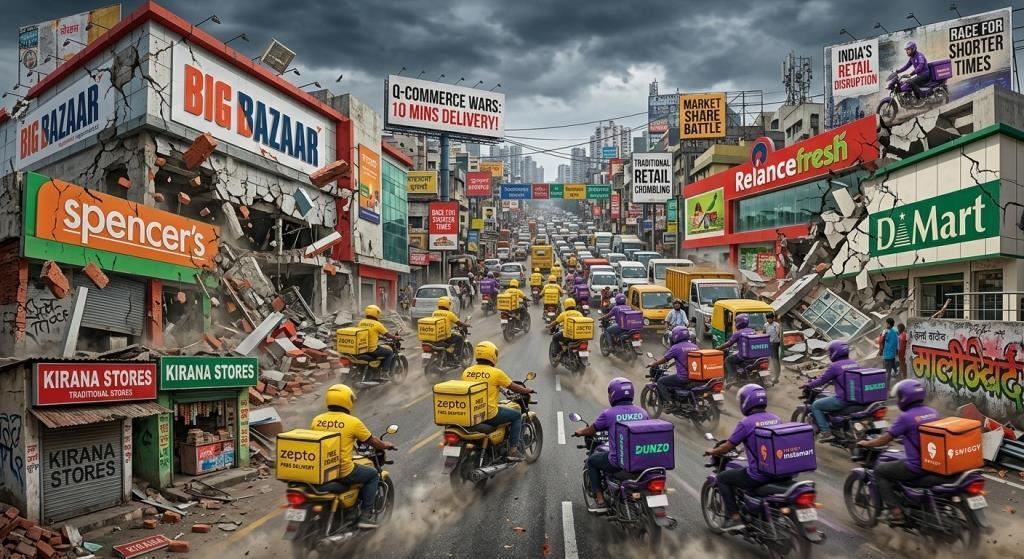
All these platforms started in India were riding the investor confidence as Softbank and other major VCs were willing to bet on young Founders ready to jump in the logistical rat race to woo their customers. Oh and they betted big! For the next decade almost none of the players made profits. This was perhaps the biggest cash burn in Startup sector to gain customers, their wallet shares and their mind space. From vendor exploitation to digital dark practices, no strategy was considered too ridiculous. This was the biggest reset of consumer consumption patterns in decades, ultimately threatening the traditional grocery stores to now almost giving modern retail giants a run for their money.
But all that may not have happened if there was not for the quiet acquisition of Blinkit (Formerly Grophers) in 2022, just as the world was coming out of the Covid-19 pandemic. The deal is one of the most interesting case studies but is rarely talked about. First a loan of $150 Million from Zomato helped settle some bills while keeping the company afloat. Then a $568 Million acquisition by Zomato, all within a few months period. What transpired, changed the course of quick commerce in India. While riding on the first mover advantage and being the first major Unicorn in delivery startups to file for an IPO back in 2021, Zomato took 15 years to turn profitable. Being said that, the Blinkit acquisition is especially significant because while this deal was happening, despite the IPO, Zomato was not profitable. Zomato turned profits in 2023, about a year later when BlinkIt’s business overshadowed Zomato’s. That’s perhaps one of the luckiest moves in startup history.
From Food to Grocery to a “Dark Store” for Everything
What started out as a promise to deliver your food while it’s still hot, it quickly escalated to a drawn out, royal rumble of platforms trying to outdo each other on what else can you order online and get delivered in minutes. While American platform DoorDash may have been the original inspiration behind Swiggy and Zomato, but in India these homegrown brands got truly verbified. The battle is still raging and these two old players are locked in. The food delivery apps had a shaky start with quality issues and delivery persons taking actual bite out of customer’s food. Today, no one is talking about that. These Tech-Logistics companies have pretty much solved those concerns apart from sporadic incidents which get buried in customer helpline.
The upswing in online ordering of food during lockdowns opened up possibilities for delivering other items. The real bottomline came from grocery delivery business. Grocery delivery is a far wider market which was dominated by traditional retail giants fighting their war in the modern retail space like Big Bazaar and Reliance Retail. These corporate backed entities suddenly came gatecrashing into quick commerce with JioMart in 2019. Swiggy launched Swiggy Instamart in 2020 and then came Zepto, the wild card.
Launched in 2021, Zepto unleashed its purple fever among online delivery startups and made ‘under 10 minute deliveries’ a matter of prestige. The second wave of Coronavirus pandemic saw this new thing emerge, called the “Dark Store”. A bespoke retail franchise and temple of convenience where riders in uniforms went in; picked up a pre-packed package and left; delivered the package to the customer located not more than a couple of kilometers. The cycle repeats all day, sometimes, compromising rider’s safety and often risking customer’s shopping addiction.
Today, you can order Grocery, Cosmetics, Toys, Medicine, Furniture, Appliances and even Computer Hardware and Accessories. In India, in tier II and tier III cities. That’s the convenience revolution which is rapidly transforming India at its core.
The Hyperlocal Paragon
While quick-commerce has gripped the nation with its investor fuelled, high convenience benchmarks, the ideal hyperlocal delivery through retail stores remains elusive. Dunzo became the most important startup in hyperlocal grocery delivery space in 2017 when it raised a USD 12 Million investment in second round from Google as lead and yet another round of USD 240 Million in 2022 lead by Reliance Retail. Dunzo reached its peak valuation of USD 775 Million and then by late 2023 key people left, company started struggling to scale further, new competition – Swiggy, Blinkit and Zepto, started killing their business. Employees were laid off but the downsizing didn’t help and the app shut down in January 2025 following the exit of the Founder. Reliance reportedly wrote off USD 200 Million.
The Covid-19 pandemic between 2020 to 2022 showed the need for delivery apps as the lockdowns prevented people from going out to get the essentials. Somewhere in this period, the fledgling business models of delivery apps turned mainstream. Swiggy Instamart, Zepto, JioMart and a host of others started aggressively expanding. Magicpin which remains afloat as an anomaly in this segment also started during this period. Realizing the potential consequences of an unchecked market controlled by e-commerce and logistics companies, the Government of India launched the ONDC (Open Network for Digital Commerce) to facilitate vendors, sellers, platform owners, and logistics providers through a standardized framework which ensures consumer protection, delivery quality and technological capabilities. To improve the margins of small retailers and to simplify their procurement, distributor and brand access, the Indian government launched DigiDukaan on ONDC platform in 2026. While there has been very good response for ONDC and many online platforms are incorporating their framework, it is yet to bring a big impact to the overall customer experience and wallet.
The Battle Intensified
Swiggy Instamart is the third player in the arena and has been expanding since 2020. Although they resisted at first, the rise of 10 minute delivery model was so disruptive that the traditional e-Commerce leaders like Amazon and FlipKart also had to launch their respective q-commerce operations. In 2024, Amazon launched Amazon Now and Flipkart launched Flipkart Minutes, both of which have been steadily catching up.
In May 2024, JioMart entered the quick commerce game by announcing 30 minute delivery. Until then JioMart only offered next day delivery or slotted delivery. They tested out their quick commerce model without dark stores but by utilizing over 19,000 stores which were already there. It is worth noting that JioMart is owned by Reliance – one of the largest conglomerates of India.
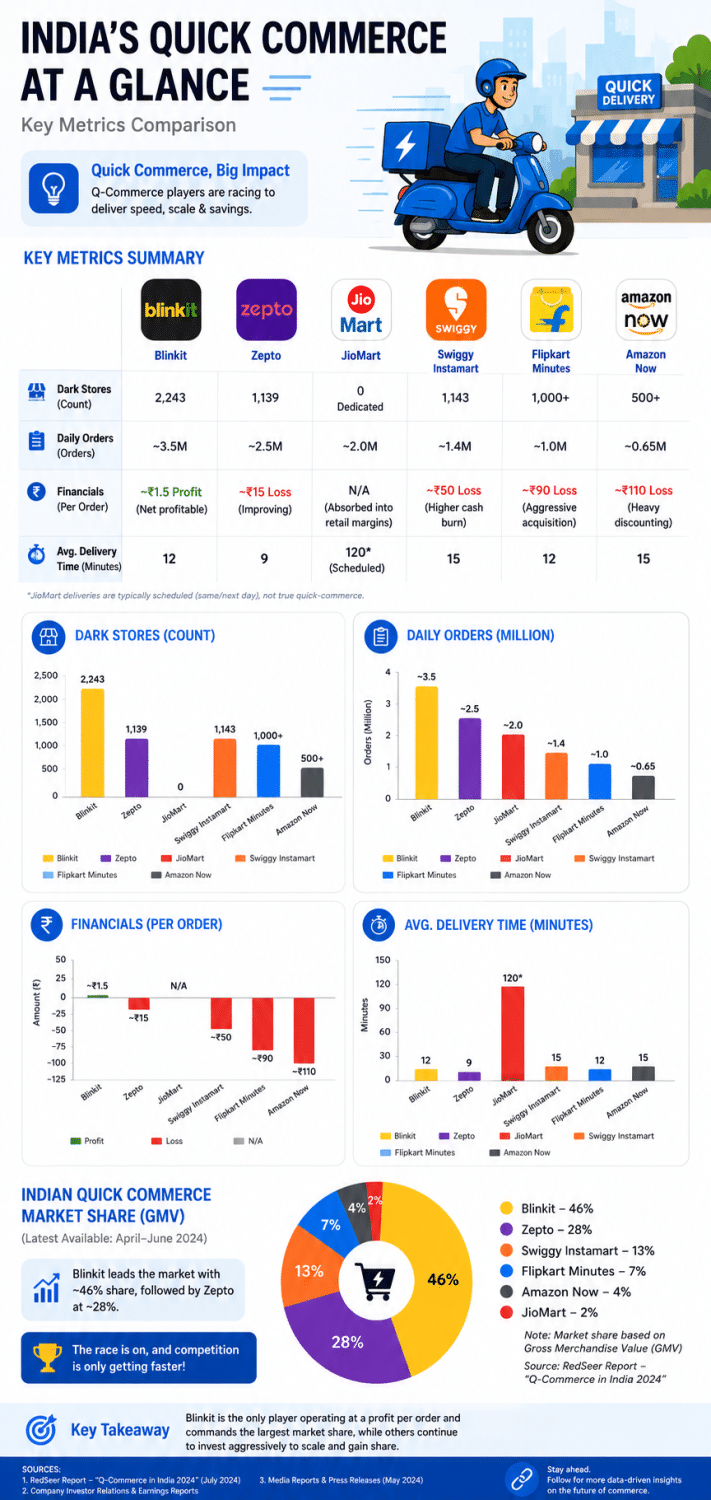
In August 2026, it was reported that BlinkIt held a little over 36% of the marketshare, while Zepto, its closest challenger controls 26% and Swiggy Instamart is at 3rd position with 14.4% marketshare.
While JioMart was attempting to break into the space where BlinkIt and Zepto were locked in a battle of expansion.
The Burn and Store Density and IPOs
Although as of 2026, these businesses are stabilizing, the cash burn to achieve the scale these businesses was phenomenal. Throughout the period of these platforms launched their 10 minute delivery, the sector has been a battleground for market share. The mounting stakes required quick expansion riding on investor’s money.
The dark-store race is rapidly becoming a network-density and manpower race. By Q2 FY26, Blinkit, Zepto, Swiggy Instamart, Flipkart Minutes and Amazon Now had collectively reached around 6,500 dark stores, after adding roughly 900 stores in a single quarter; however, nearly 9 in 10 of those additions were in pincodes that already had quick-commerce presence, signalling increasing densification rather than geographic expansion. On the workforce side, Blinkit, Zepto and Instamart alone were estimated to have 4.5–5 lakh monthly active delivery partners in late 2025, up 70–80% from 2.5–3 lakh a year earlier. By August 2026, the infrastructure had expanded further: Blinkit was at 2,243 stores, Zepto 1,139 and Instamart around 1,171, while Flipkart Minutes had crossed 1,000 and was targeting 1,500 by year-end. The caution is that more stores and riders don’t automatically mean better economics—companies are increasingly competing for the same urban demand, making store productivity, rider utilisation and orders per dark store more important than simply adding capacity.
The IPO wave is also forcing quick-commerce players to demonstrate a clearer path to profitability—but the improvement should be viewed cautiously. Swiggy raised ₹11,327 crore in its 2024 IPO, while Zepto’s proposed IPO includes a ₹8,010 crore fresh issue. Ahead of its IPO, Zepto’s Q4 FY26 adjusted EBITDA loss narrowed to ₹1,248 crore, or ₹59.4 per order, from ₹142.7 per order a year earlier, although its full-year net loss actually widened to ₹5,905 crore. Meanwhile, Blinkit reported ₹37 crore adjusted EBITDA profit in Q4 FY26, and Swiggy Instamart improved its contribution margin from -1.8% to -0.2% of GOV in Q1 FY27. The IPO effect, therefore, is less about magically creating profits and more about imposing public-market pressure to improve unit economics, store productivity, advertising revenue and customer quality. But with Zepto still losing money at scale and Swiggy targeting profitability only over the longer term, it is too early to conclude that the sector has structurally achieved sustainable profitability.
| Platform | Dark Stores | Daily Orders | Financials (Per Order) | Avg. Delivery Time |
| Blinkit | 2,243 | ~3.5 Million | ~₹1.5 Profit (Net profitable) | 12 Minutes |
| Zepto | 1,139 | ~2.5 Million | ~₹15 Loss (Improving) | 9 Minutes |
| JioMart | 0 Dedicated | ~2.0 Million | N/A (Absorbed into retail margins) | 2 Hours / Scheduled |
| Swiggy Instamart | 1,143 | ~1.4 Million | ~₹50 Loss (Higher cash burn) | 15 Minutes |
| Flipkart Minutes | 1,000+ | ~1.0 Million | ~₹90 Loss (Aggressive customer acquisition) | 12 Minutes |
| Amazon Now | 500+ | ~0.65 Million | ~₹110 Loss (Heavy discounting/waived fees) | 15 Minutes |
Dark Practices and Quality concerns
Quick Commerce has been a revolutionary concept and to see it work out at the scale and level of accessibility in a country like India, vast in both geography and demography, in nothing short of impressive. While this is amazing and many foreigners who travel to India find it fascinating, there are some concerns with the actual economics and the tactics used by these platforms to maintain those numbers.
Many have reported that these platforms employ deceptive methods in product pricing and billing to delivery of items. There are misleading campaigns, tricks, offers and other ways in which customers are billed way more than the market price. The just-in-time delivery infrastructure is expensive to manage and the customers are generally open to paying more for convenience. The quick commerce platforms may be taking this to a little extreme.
Research papers have been published on how these platforms are using UI tricks to overcome price sensitivity. The common practices are hidden information, fine prints, bait and switch, manufactured scarcity and creating confusing product variants with misdirection in quality or quantity being sold.
A very common observation is that these platforms create urgency by limited time offers on the product for which the pricing is already inflated. There are absolutely no standards on the weights of green grocery being delivered loose. There are often surge pricing where price of a particular product will vastly vary on day to day basis.
Since 2025, there have been frequent raids on the dark stores of these quick commerce platforms by the administration. The FSSAI, and the Food and Drug Administration have been exposing the conditions of these dark stores and have been penalizing the platforms for not adhering to the quality, food safety and hygiene standards.
The daunting issue is that there is no specific rulebook for operating dark stores, there are no inspection guidelines. The amount of penalty the regulator imposes on these dark stores found to be non-compliant and infested with pests is miniscule compared to the revenue and funding of these platform startups. In fact, beyond a few reels going viral about the condition of these dark stores, you won’t find much information on the internet.
Learnings for the Startup Founder
While there may be many perfectly realistic startup ideas out there, the quick commerce concept fetched the most funding, gained the most valuations and saw repeated investments despite massive losses.
What began as an outrageous claim about delivery speeds became the battle cry for war on retail market share. The shortening of delivery time disrupted the customer experience matrix to such an extent that it completely distinguished itself from the conventional e-commerce. Just receiving the goods at doorstep no longer remained the primary convenience. Receiving in next 10 minutes became the new paradigm.
Founders planning their startups don’t always need to invent a new problem statement. They can just extend the existing one and create new benchmarks in time and cost.
Finally, execution and ability to challenge the perceptions matter the most. India’s consumer segments are evolving fast. The typical price sensitive Indian is spending more on convenience and making no fuss about it.
Founders need to able to find the right market to launch and test their products. India’s metro cities, especially Delhi NCR, Bengaluru and Mumbai offer the hotbeds for such product trials. However, the Tier II and Tier III may not be far behind.
A consolidated list of major and upcoming delivery platforms:
| Launch Year | Platform | Category | Founder(s) | Funding Raised (Approx.) | Avg. Delivery Time | Presence | Acquisition / Parent | Status |
| 2008 | Zomato | Restaurant Discovery → Food Delivery | Deepinder Goyal, Pankaj Chaddah | ~$2.3B (pre-IPO) | 30–45 min | Pan India | Acquired Blinkit (2022); renamed parent to Eternal (2025) | Active |
| 2011 | BigBasket | Grocery | Hari Menon, Vipul Parekh, V.S. Sudhakar, Vipul Parekh, Abhinay Choudhari | ~$1.3B | Next day → 10–30 min (BB Now) | Pan India | Majority acquired by Tata Digital (2021) | Active |
| 2013 | Grofers → Blinkit | Grocery | Albinder Dhindsa, Saurabh Kumar | ~$1.2B+ | 90 min → 10 min | Pan India | Acquired by Zomato (2022) | Active. Rebranded 2021 |
| 2014 | TinyOwl | Food Delivery | Gaurav Choudhary, Harshvardhan Lunia, Saurabh Gupta | ~$27M | 30–45 min | Metro Cities | Acquired by Roadrunnr (2016) | Closed. Brand discontinued 2016 |
| 2014 | Dunzo | Hyperlocal | Kabeer Biswas, Dalvir Suri, Mukund Jha, Ankur Aggarwal | ~$500M | 30–45 min | Major Cities | Backed by Google and Reliance Retail | Effectively Closed. Operations wound down during 2024–25 |
| 2014 | PepperTap | Grocery | Navneet Singh, Milind Sharma | ~$51M | Same Day | NCR | — | Shut down 2016 |
| 2015 | Swiggy | Food Delivery | Sriharsha Majety, Nandan Reddy, Rahul Jaimini | ~$3.6B | 30–45 min | Pan India | Public Company | Active |
| 2015 | Licious | Meat & Seafood | Vivek Gupta, Abhay Hanjura | ~$490M | 30–90 min | Multi-city | — | Active |
| 2015 | ZopNow | Grocery | Mukesh Singh | ~$15M | Same Day | Bengaluru | — | Shut down 2017 |
| 2016 | FreshToHome | Meat & Seafood | Shan Kadavil, Mathew Joseph | ~$180M | 60–120 min | Regional | — | Active |
| 2016 | Milkbasket | Daily Grocery | Anant Goel, Ashish Goel | ~$40M | Morning Delivery | NCR | Acquired by Reliance (2021) | Acquired – Brand integrated |
| 2016 | DailyNinja | Milk & Grocery | Anurag Gupta | ~$10M | Scheduled | Bengaluru | — | Shut down 2020 |
| 2018 | Country Delight | Dairy | Chakradhar Gade, Nitin Kaushal | ~$220M | Morning / Same Day | Multi-city | — | Active |
| 2019 | JioMart | Grocery | Reliance Retail | Corporate | Same Day → 10–30 min | Pan India | Reliance Retail | Active |
| 2020 | Swiggy Instamart | Grocery | Swiggy | Internal | 10–20 min | Pan India | Swiggy | Active |
| 2020 | Ola Dash | Grocery | Ola | Internal | 10–15 min | Limited | Ola | Closed 2022 |
| 2021 | Zepto | Grocery | Aadit Palicha, Kaivalya Vohra | ~$2B+ | 10 min | Pan India | Independent | Active |
| 2021 | BB Now | Grocery | BigBasket | Internal | 10–20 min | Pan India | Tata Digital | Active |
| 2021 | Dunzo Daily | Grocery | Dunzo | Internal | 15–20 min | Limited | Dunzo | Closed 2023 |
| 2022 | Magicpin | Food & Grocery | Anshoo Sharma, Brij Bhushan | ~$250M | 15–30 min | Multi-city | — | Active |
| 2023 | Myntra M-Now | Fashion | Myntra | Internal | 30 min | Major Cities | Flipkart Group | Active |
| 2024 | Flipkart Minutes | Grocery, Electronics | Flipkart | Internal | 10–15 min | Expanding | Walmart-owned Flipkart | Active |
| 2024 | Amazon Now | Grocery | Amazon | Internal | 10–20 min | Selected Cities | Amazon | Active |
| 2024 | Nykaa Now | Beauty | Nykaa | Internal | 30–60 min | Selected Cities | Nykaa | Active |
| 2025 | Toing | Affordable Food Delivery | Swiggy | Internal | 20–30 min | Expanding | Swiggy standalone brand | Active (pilot launched in Pune, later expanded to multiple cities) |
| 2025 | Slikk | Fashion | Founding team undisclosed publicly | Seed | 60 min | Bengaluru | — | Active |