








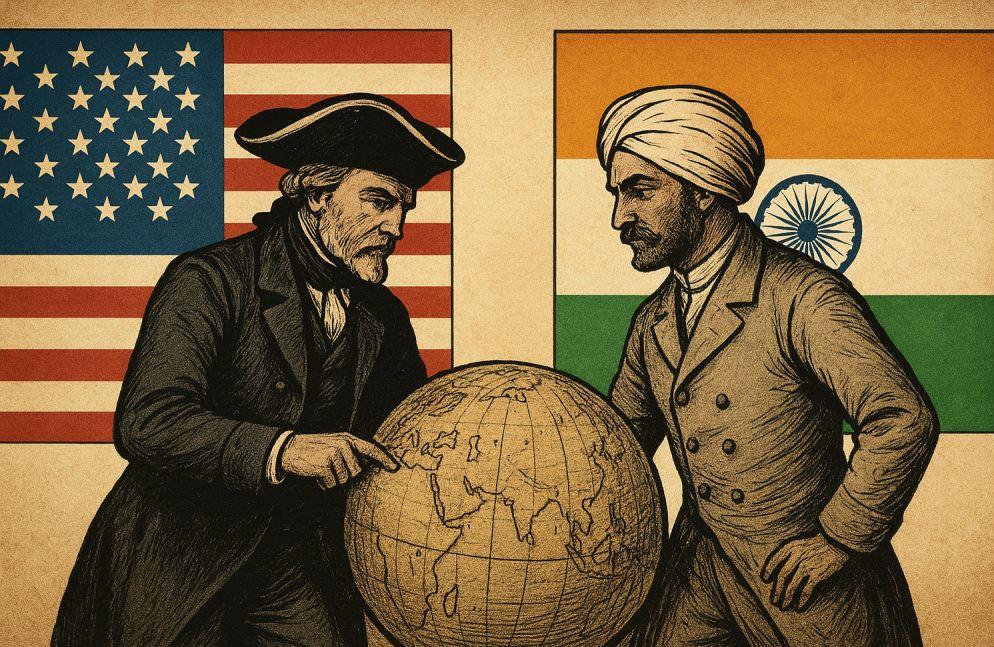
A few months ago we had analyzed Donald Trump’s tariffs on Chinese goods and the revelations of luxury brands being mass produced in China in its aftermath. Now Trump’s trade guns are blazing again – this time aimed at India. With tariffs on Indian imports now doubled to 50%, Washington seems less focused on “leveling the playing field” and more on sending a geopolitical message. The White House justifies the move by pointing to India’s reliance on cheap Russian oil, but the carve-outs in this tariff drama tell a much bigger story.
Strangely enough, in this latest chapter of the global trade war, the Trump administration has shifted its crosshairs. For years, the White House’s economic firepower was trained squarely on Beijing, with tariffs framed as weapons to slow Chinese growth and protect American industry. But now, Washington seems to have taken a detour – turning its attention to New Delhi, a supposed ally, and slapping tariffs that risk alienating one of America’s few reliable partners in Asia.
This pivot raises uncomfortable questions: Why pick a fight with a democratic ally at a time when the U.S. needs India as a counterbalance to China? Why punish labour-driven goods that have little to do with strategic competition? And why, curiously, keep America’s biggest dependencies—smartphones, semiconductors, and refined oil—safely outside the tariff dragnet?
The answers lie somewhere between geopolitical chess, domestic politics, and the stubborn push of U.S. corporate interests.
Who Gets Hit and Who Walks Free
The hardest-hit categories are labour-intensive industries—handicrafts, leather goods, gems and jewelry, food products, chemicals, and auto components. In short, the very sectors where India has traditionally outshone the U.S. through scale, craftsmanship, and price advantage.
That intricate silver jewelry in a Manhattan boutique, the hand-carved wooden furniture sold in Texas suburbs, the organic spice blends sitting on Whole Foods shelves, the leather jackets trending in Brooklyn, and the cotton bedsheets in your Airbnb—all come from Indian hands.
But curiously, oil imports from India are not stopping. Also the imports of smartphones and semiconductors – arguably India’s biggest and most strategic exports to the U.S. are left out of these tariffs. Furthermore, there are no punitive tariffs on China which is a many times larger importer of Russian oil. These exemptions suggest Washington isn’t trying to strangle Indian trade entirely, but rather squeeze the areas that matter to India’s massive employment base. Behind the scenes, another sore point is brewing: New Delhi’s reluctance to allow U.S. agri-giants to flood its market with GMO crops and foods.
The Geopolitical Chessboard
The deeper play here isn’t about trade deficits—it’s about geopolitical alignments. By squeezing India under the pretext of Russian oil imports, Trump is sending New Delhi a signal: fall in line with Washington’s foreign policy priorities, or pay the price. Ironically, India has been a crucial counterweight to China in U.S. strategy, but these tariffs risk alienating exactly the ally America cannot afford to lose.
The beginning of the Russia-Ukraine conflict can be traced back to 2014 when Russia annexed Crimea and that had nothing to do with India or the oil imports. Since then, there has been political and military tango between EU, NATO backing Ukraine and Russia, while the defense sector of USA being the biggest benefactor since the conflict came to full blows in 2022.
The “Made in America” Irony
If America is truly serious about cutting imports of Indian textiles, jewelry, furniture, and leather, perhaps it’s time to dust off its sewing machines and jewelry benches. Could the U.S. really rebuild its own cheap labour force to churn out handcrafted saris, diamond-studded bangles, or intricate wooden carvings? Not likely. But the message is clear – Washington is happy to disrupt consumer comfort if it translates into geopolitical leverage.
The GMO Undercurrent
While Russian oil is the official excuse, the quiet backdrop to this tariff war is India’s firm resistance to genetically modified crops and food imports. U.S. agribusiness giants have long wanted access to India’s vast consumer base for GMO soy, corn, and packaged foods. But India’s regulatory barriers, coupled with public distrust of GMO products, have kept that door shut.
India’s food and dairy industry has been eyed by global players for a while. However, even companies like Monsanto and Cargill have had limited entry and GMO based foods are just not what Indians want. India has been investing in the non-GMO, natural and organic food movement in the past decade. Their ‘Year of the Millets’ and ‘National Mission for Natural Farming’ have been pushing for chemical free and sustainable farming practices to keep GMO crops at bay.
For Trump’s America, this refusal isn’t just economic – it’s ideological. By slapping tariffs on India’s labour-driven exports, Washington is essentially saying: if you won’t let our corn syrup and engineered soy flood your markets, we’ll make you pay in jewelry, leather, and spices.
India’s Next Play
There is a clear indication that India is not going to back down. They have strategically started engaging with African and South East Asian countries for diversifying their markets. If they lose American markets, the impact would probably not be that much. While that may be a bold thing to say, but their focus on domestic markets and push for indigenization has been gaining momentum lately.
Interestingly, for India, this tariff shock may be the much-needed push to move further up the value chain. Instead of depending on labour-intensive exports, it could double down on high-tech manufacturing, EVs, pharmaceuticals, and semiconductors – sectors where U.S. tariffs seem suspiciously absent. With China and Russia already deepening their trade axis, New Delhi may have fewer reasons to remain politely “non-aligned.” In a way, the BRICS bloc is its own alliance which another completely different aspect of this game. There are rumors of a potential BRICS currency which could theoretically replace the US Dollar as the currency of global trade exchange. Whether the BRICS currency will ever materialize or not, the financial arrangements between this mix of large sized economies is quite enough to create a new world order. One that is beyond the old Capitalist and Socialist blocs of the past.
Polarized Future
It is of course, unfortunate to see the long standing relationship between two of the largest democracies of the world getting stressed due to the strongman “deal making” tactics of Trump on behalf of those who seek to personally profit from the potential trade leeway. While the war between Russia and Ukraine which has been going on for years now, it hardly looks like stopping. Even after the meeting between Trump and Putin in Alaska, there is no clear indication of efforts to de-escalate. Whether India profiteers from this war or not, the actual blame of perpetuating the war between Russia and Ukraine cannot be shifted to India as the root cause lies in the geopolitics of the region. For Indians, the question of energy security is a larger one than any trade deals that Mr. Trump could likely throw at them.
Trump’s tariff strategy is polarizing the world faster than any diplomatic summit ever could. India is left with a choice: accept Washington’s economic arm-twisting, or turn adversity into opportunity by embracing new partners and tech-driven exports.
One thing is certain – this isn’t just a tariff war. It’s an attempt to redraw the lines of global influence, one tax at a time.
At The Local Brand(R) we seldom focus on global politics. However we are covering this topic because this trade war is going to affect the global supply chains. As a result a lot of livelihoods and local businesses may get disrupted. We think that local businesses are resilient and would find ways to cope this emerging situation. Please respond to this short survey on the Trade War and share your opinion.