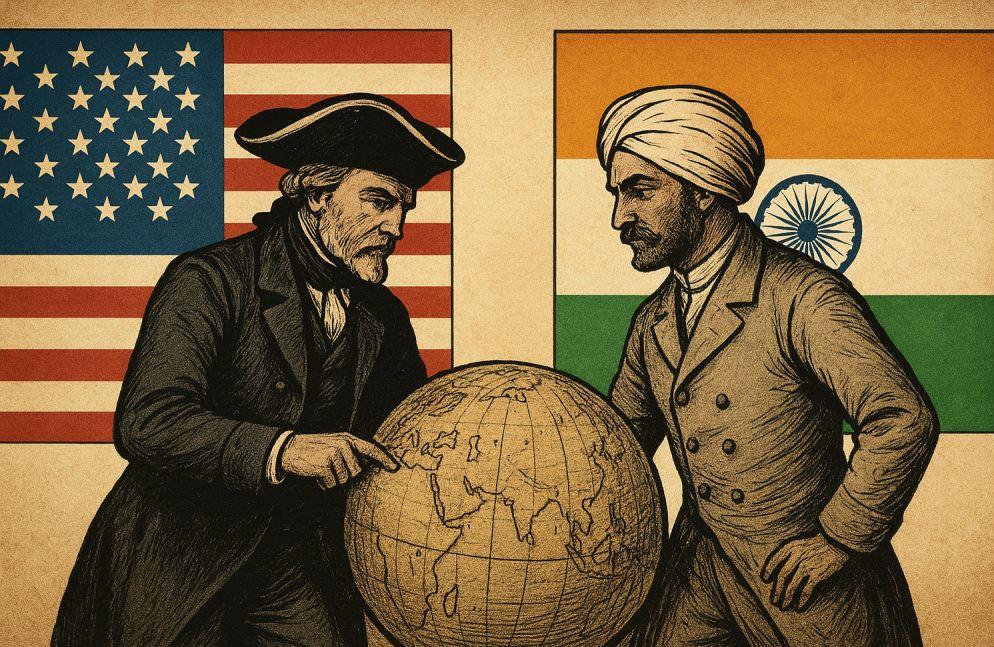








As we navigate the early months of 2026, the global economic landscape resembles a high-stakes obstacle course. What began years ago as isolated tariff disputes has evolved into a structural dismantling of global trade. Today, local businesses find themselves caught in a “triple whammy”: the persistent disruption of supply chains by regional wars, a volatile energy market, and the silent but swift displacement of the workforce by Artificial Intelligence (AI).
The Fragility of the Global Web
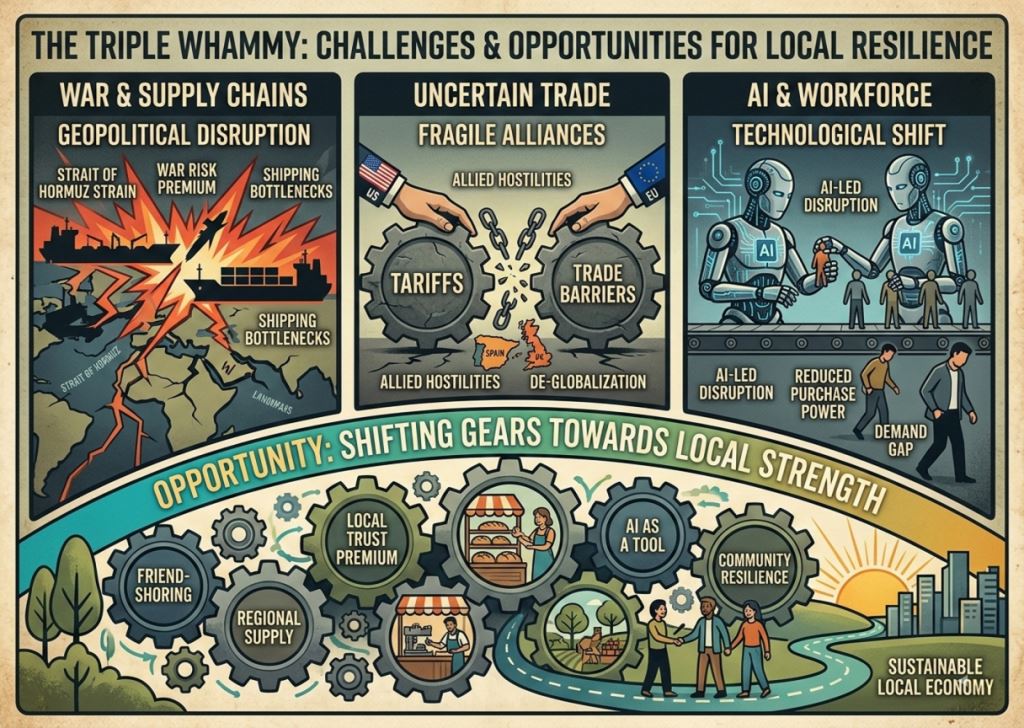
The “just-in-time” manufacturing model that defined the last three decades has officially fractured. Protracted conflicts, notably in Eastern Europe and the Middle East, have turned critical maritime chokepoints like the Red Sea and the Strait of Hormuz into zones of extreme risk. For a local boutique or a regional manufacturer, this isn’t just a headline—it is a direct hit to the bottom line.
Shipping and Crude Realities
Global shipping lines are currently under immense strain, with the World Economic Forum noting that businesses now face a 27% annual probability of a significant supply chain disruption. These bottlenecks are exacerbated by a “geopolitical risk premium” on oil.
In early 2026, Brent crude has seen surges of $4 to $10 per barrel specifically due to hostilities involving the U.S. and Iran. For local businesses, this translates to “hotter” inflation and higher transportation costs that erode already thin margins.
Hostilities Among “Allies” and the Service Slump
Perhaps more concerning is the erosion of trust between traditional allies. Recent diplomatic friction between the U.S. and European partners like Spain and the UK—fueled by aggressive new tariff impositions—has created a “spiral of escalation.”
This geopolitical frostbite is beginning to nip at the heels of the tourism and service sectors. While Spain’s tourism remains resilient for now, the threat of mobility restrictions and “obnoxious” tariffs on services makes international expansion a minefield for SMEs. When allies begin to treat each other as trade adversaries, the local cafe in London or the hotelier in Madrid faces a shrinking pool of affluent international travelers and rising costs for imported goods.
The AI Shadow: A Workforce in Flux
The third pillar of this crisis is the AI-led workforce disruption. By the end of 2026, nearly 37% of companies expect to replace certain roles with AI. This isn’t just about robots in factories; it’s about generative AI taking over document analysis, customer service, and entry-level professional tasks.
| Sector | AI Exposure | Primary Risk |
| Manufacturing | High (Automation) | Supply chain bottlenecks & high energy costs |
| Retail/Service | Medium (Augmentation) | Reduced consumer purchase power |
| White-Collar | High (Displacement) | Loss of entry-level “stepping stone” jobs |
This creates a dangerous demand gap. As AI displaces entry-level workers and mid-tier professionals, the purchasing power of the local community wanes. Local businesses may find themselves with plenty of AI-driven efficiency but no customers with the disposable income to buy their products.
Shifting Gears: The Local Opportunity
Despite this grim forecast, this period of de-globalization offers a unique, if forced, opportunity for local businesses to “shift gears.” When global trade is dismantled, the local becomes the only reliable link.
- Regionalizing Supply: Successful local firms are moving away from cost-driven offshoring toward risk-managed “friend-shoring.” By sourcing materials within their own borders or from stable neighbors, they bypass the volatility of the Strait of Hormuz.
- Reignite Go-Local Movements: Perhaps this is the right time for local businesses to target the customers with the benefits of buying local. The Vocal-for-Local and Shop-Local movements can be rekindled in the wake of these new scenario of war, AI and trade uncertainties.
- The Trust Premium: In a world of digital deepfakes and automated service bots, human-centric local businesses can thrive. Reports show that 77% of small business marketers are now investing in community-driven, authentic content to build a “trust premium” that big tech cannot replicate.
- AI as a Tool, Not a Replacement: Small businesses that use AI to save time—estimated at up to 12 hours a week—rather than to cut staff, are seeing 2.5x higher revenue growth.
Conclusion
The convergence of war, trade barriers, and AI displacement is a sobering reality for 2026. However, by turning inward to strengthen community ties and outward only to secure resilient, regional supply lines, local businesses can transform this “triple whammy” into a new era of self-reliance. The global web may be fraying, but the local knot can still hold strong.
Sources Cited:
2026’s supply chain challenge: Confronting complexity and disruption in global trade [Thomson Reuters]
Energy prices surge as global stocks slide on geopolitical tensions [Equiti]
Lingering geopolitical uncertainty requires a crude rethink [ING]
Supply Chain Disruption and How to Manage It [2026 Insight] [Elite Asia]
Geopolitical Tensions Drive Oil Price Surge In 2026 [Grand Pinnacle Tribune]
Iran Conflict: Seven Takeaways for Investors [Morgan Stanley]
Trump tariff threats risk triggering ‘spiral of escalation’ in world economy, says IMF [The Guardian]
AI’s Impact on Jobs in 2026: The Real Trends Every Professional Should Know [GSDC]
10 trends shaping global trade in 2026 [UNCTAD]
How Small Businesses Can Win in 2026 [LinkedIn Economic Graph]