










For decades, the global aviation industry has been dominated by a duopoly—Boeing and Airbus—delivering giant, expensive, slow-to-manufacture aircraft to a small circle of airlines operating under high costs and tight margins. These legacy aircraft, while marvels of engineering, require immense resources to build, operate, and maintain. The result is an inflexible aviation model, heavily dependent on fossil fuels, large airports, and centralized networks, often out of reach for emerging markets and rural regions.
This traditional airline model is also deeply reliant on the regular delivery of next-generation commercial aircraft by Boeing and Airbus to remain viable. However, both manufacturers have faced mounting challenges. Production delays—exacerbated by supply chain disruptions, labor shortages, and certification setbacks—have significantly slowed aircraft rollouts. Meanwhile, the industry has been rattled by repeated safety incidents, including the grounding of the Boeing 737 MAX, and financial instability, with some major carriers teetering on the edge of bankruptcy.
Most recently, the crash of an Air India domestic flight in early 2025 has cast a fresh spotlight on the vulnerabilities of the traditional aviation ecosystem. Preliminary findings from the ongoing investigation point to critical software malfunctions and delayed hardware replacements, prompting renewed scrutiny of maintenance regimes and manufacturer accountability. This incident underscores the systemic fragility that emerges when airlines are tied to a handful of manufacturers and face steep operational costs and limited technological agility.
However, a revolution is underway.
Startups Disrupting the Aviation Monopoly
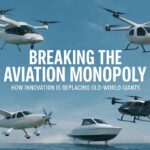
A new generation of startups is challenging this old-world model. They are introducing electric, lightweight, and highly efficient aircraft and aviation alternatives that are not only cheaper and quicker to manufacture but also easier to operate and maintain.
These startups focus on short-haul, regional, and water-based transit options—niches neglected by traditional aerospace giants. Their innovative solutions are designed for point-to-point transport, decentralized operations, and minimal infrastructure dependency.
Sarla Aviation (India)
Looking to solve the rising issue of traffic in urban cosmopolitan, this aviation startup is building “Drone Taxis”. Based in Bengaluru and co-founded by German aerospace engineer Adrian Schmidt (ex-Lilium, Mercedes-Benz) along with Indian technologists Rakesh Gaonkar, Shivam Chauhan, and Ankit Patel, Sarla Aviation is developing a seven-seat electric vertical takeoff and landing (eVTOL) aircraft called “Shunya.” Designed like a quadcopter, it targets short intra-city hops (20–30 km) at speeds up to 250 km/h, aiming to relieve traffic congestion in Indian cities and offer services like air ambulances. The startup is currently gaining a lot of attention and is raising funds.
Navier (USA)
Not everyone is fond of flying. Many cities and coastal towns are well suited for using waterways as more optimal, safer transportation and high volume traffic. Founded by Indian-origin entrepreneur Sampriti Bhattacharyya, Navier is developing electric hydrofoil boats. The Navier N30 glides about 4 feet above water at 35 knots (~65 km/h), using sensor-driven autonomy and high efficiency to reinvent urban coastal mobility. These boats are more comfortable, efficient and fun way to commute.
Joby Aviation (USA)
Vying for the commercialization of electric VTOL or eVTOL aircrafts, this company is raising funds and making headlines. Founded by serial entrepreneur and long-time sustainable aviation enthusiast, JoeBen Bevirt, Joby is a leading eVTOL company creating electric air taxis with a 240 km range and 320 km/h speed. Joby targets urban and regional hops with aircraft that are quieter, cleaner, and more flexible than helicopters.
Beta Technologies (USA)
Founded by Kyle Clark in 2017, Beta focuses on electric (eVTOL and eCTOL) aircrafts for cargo and passengers. This startup has the distinction of completing the first commercial passenger flight using electric aircraft recently in June 2025. Its five-passenger ALIA aircraft integrates real-time diagnostics, vertical and horizontal flight modes, and zero-emission systems.
REGENT Craft (USA/Europe)
There is a lot of potential in seagliders. They certainly seem safer than conventional aeroplanes. Co-founded by Billy Thalheimer and Mike Klinker, REGENT is building electric seagliders using wing-in-ground effect, targeting island and coastal routes. Their Viceroy prototype promises up to 290 km range at speeds of 290 km/h, optimized for regional travel.
LAT Aerospace (India)
Backed by Deepinder Goyal of Zomato (Eternal) and cofounded by IIM Ahmedabad alumni Surobhi Das, LAT Aerospace recently came into news due to rumours of acquiring a private jet from Bombardier. While Deepinder refuted any such claims, he states that the company is poised to develop next generation aircraft built for affordability and would “rewrite rules of flight”. The company is planning on manufacturing hybrid-electric, short takeoff and landing (STOL) aircraft tailored for low-cost regional air mobility. Their focus is on simplifying aircraft architecture for operations in remote or infrastructure-light areas.
Waterfly Technologies (India)
Incubated at IIT Madras, Waterfly is developing electric seagliders—wing-in-ground effect craft designed to travel just above the water surface at high speeds (~500 km/h). These vehicles promise fast, affordable, and low-emission coastal connectivity. The startup was appreciated by known automotive entrepreneur Anand Mahindra. They claim to launch affordable 3 hour flights from Chennai to Kolkata once their aircraft is flightworthy.
The New vs The Old: A Subjective Comparison
Compared to traditional giants like Boeing and Airbus or even private aircraft manufacturers like Saab, Gulfstream, Cessna, Bombardier etc., these alternative aviation startups offer a radically different vision for the future of flight:
- Safety: While legacy aircraft benefit from decades of refinement, these startups are integrating safety through simpler mechanical systems, real-time diagnostics, and autonomous stabilization—reducing the likelihood of human error and mechanical failure.
- Speed: Traditional jets still dominate intercontinental travel. But for regional and intra-city mobility, startups offer faster point-to-point options by cutting airport dwell time, boarding delays, and indirect routing.
- Convenience: Legacy aviation relies on centralized hubs, requiring lengthy travel to and from major airports. Startups offer distributed, local, and more flexible services—vertiports, water-based docks, and short strips make their networks more accessible.
- Energy Efficiency: Jet fuel is expensive and carbon-intensive. New aircraft use electric propulsion and advanced aerodynamics to drastically reduce operational emissions, noise, and fuel costs.
- Innovation: The giants innovate incrementally; startups innovate fundamentally. From vertical flight and ground-effect cruising to fully electric systems and modular designs, these companies are redefining aircraft from scratch.
What is more perplexing is that the old giants of aviation have not caught up to this trend of modernising aviation. Also there is rarely any interest among these large players in investing in these modern aviation startups. However, evolution doesn’t stop for lack of interest in changing.
Rewriting the Business Model of Flight
What separates these startups from the traditional aircraft manufacturing industrial complex is not just scale, but agility and accessibility. Their aircraft are:
- Modular and lightweight, reducing maintenance burden.
- Electric-powered, reducing emissions and noise.
- Operationally flexible, using rivers, short runways, or rooftops.
- Designed for profitability, offering lower costs per kilometer.
Unlike the bloated procurement cycles and multi-year production backlogs of legacy manufacturers, these startups iterate quickly and scale regionally, offering tailor-made mobility solutions for modern demand.
Democratizing Air Travel
Startups like Sarla Aviation, Waterfly Technologies, Navier, Joby Aviation, and REGENT are not just improving transportation—they are redesigning the very fabric of air mobility. They’re enabling safer, faster, more sustainable travel without the complexity and cost of traditional aviation. As the world shifts toward decentralization and carbon accountability, these innovators are poised to dethrone legacy monopolies and redefine how we fly.
The aviation revolution isn’t coming from a factory in Toulouse or Seattle. It’s taking off from university labs, coastal docks, and regional airstrips around the world.